
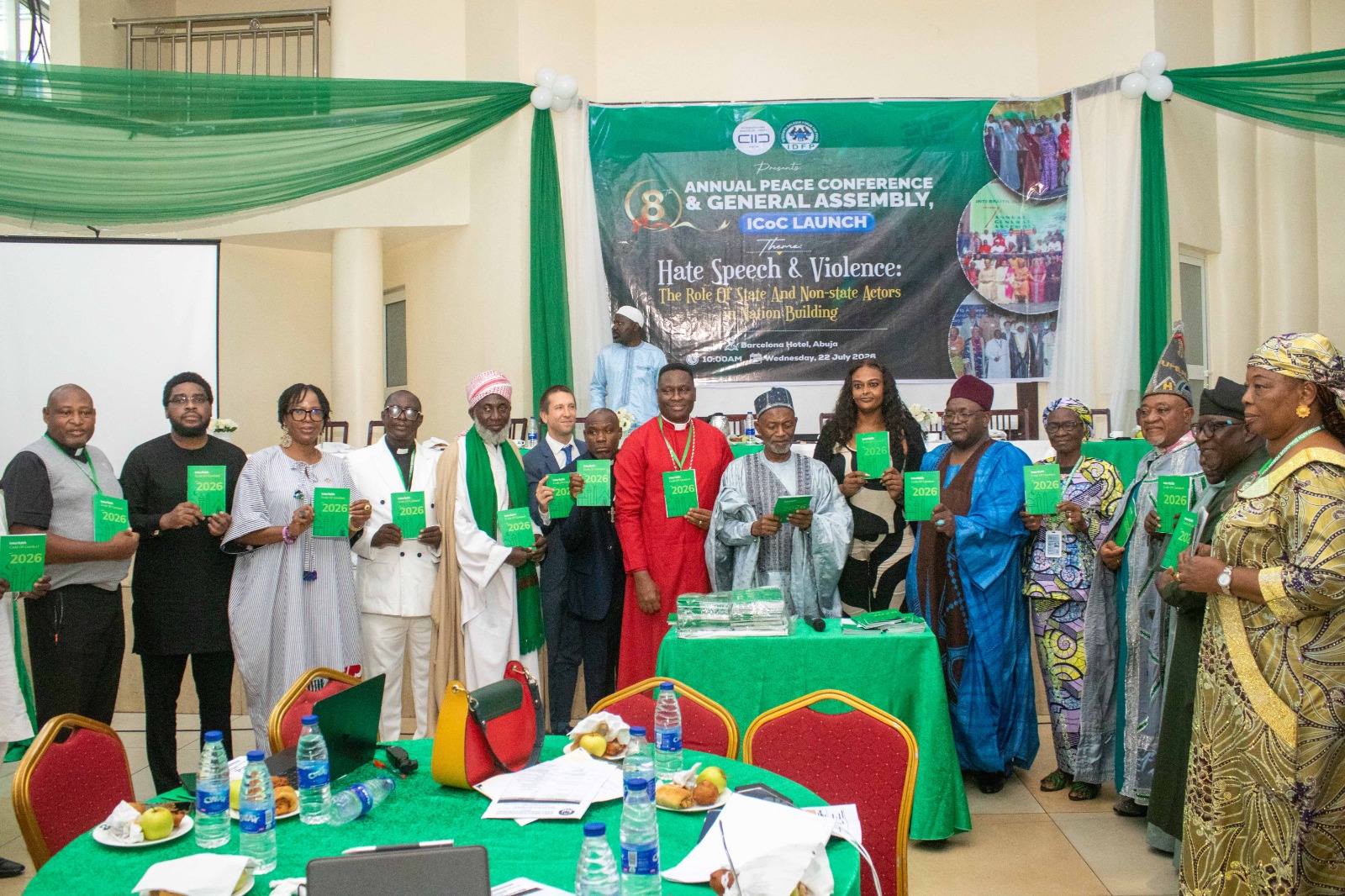
Launched at a pivotal gathering, the IDFP Abuja Peace Conference, bringing together faith communities, Christian and Muslim leaders called for a new culture of responsible speech, practical cooperation and peaceful coexistence as Nigeria moves towards the 2027 elections.
Christian and Muslim leaders from across Nigeria gathered in Abuja to launch the revised Interfaith Code of Conduct (ICoC), a shared framework designed to address hate speech, strengthen peaceful coexistence and national cohesion. The launch took place during the Abuja Peace Conference and 8th General Assembly of the Interfaith Dialogue Forum for Peace (IDFP)under the theme “Hate Speech and Violence: The Role of State and Non-State Actors in Nation-Building,” the conference brought together religious leaders, government representatives, peacebuilding practitioners, civil society organisations, journalists and representatives of women, youth and local communities. The launch formed part of a wider discussion on the responsibilities of state and non-state actors in addressing hate speech and violence as threats to peace, democratic consolidation and nation-building.
Alongside the formal presentation and launch of the Code, participants examined Nigeria’s current context and considered how the ICoC can be used to address harmful narratives, division and emerging conflict risks.
“The Code of Conduct must not remain a document on a shelf. It must become a living commitment. It must influence our words, guide our actions and shape our leadership.”
Reverand Abainitus Akila Haman Jr. Co-Chair of IDFP
IDFP convened the Abuja Peace Conference in collaboration with the Christian Association of Nigeria (CAN), the Nigerian Supreme Council for Islamic Affairs (NSCIA) and the Institute for Peace and Conflict Resolution (IPCR), with funding and support from the King Abdullah Bin Abdulaziz International Centre for Interreligious and Intercultural Dialogue – KAICIID. The conference placed a important and urgent question at the centre of the discussion: what happens when words cease to be merely words and become instruments of exclusion, manipulation and violence?
Across the keynote address, panel discussion and contributions from participants, a clear message emerged: hate speech is not simply offensive or careless language. It can operate as propaganda normalising discrimination, dehumanising individuals and communities, legitimising violence and gradually weakening the bonds that hold a diverse society together.
Professor Abubakar Sadeeque Abba of the University of Abuja, keynote speaker, warned that hate speech has become weaponised for political economic and social advantage. He described how ethnic profiling, religious intolerance, slander and attacks on communities can generate suspicion, mobilise groups against one another and create the conditions in which violence can become possible.
The risk is especially pronounced as Nigeria approaches the 2027 elections. Participants observed that political actors without credible programmes or convincing ideas may resort to ethnic, religious, regional or gender-based narratives to gain attention and mobilise supporters. The conference called for political competition to return to policies, manifestos and public services- not inflammatory rhetoric, personal attacks or incitement
The panel also drew attention to those whose experiences are often absent from public accounts of political violence. Khadijah Hawaja Gambo highlighted the “invisible casualties” borne by women and girls. The harm does not begin or end with physical assault: repeated hostile narratives can reinforce discrimination, silence women in public life and establish behavioural patterns that make intimidation and violence appear normal.
Women who enter politics, governance or professional life are frequently portrayed as threats and subjected to character assassination, threats and gendered abuse. Many incidents remain unreported, poorly investigated or unprosecuted. A case involving a female Commissioner for Women Affairs reportedly killed during an election campaign was cited to illustrate how violence against women in political spaces may receive limited attention and accountability.
Participants therefore called for stronger protection of women in politics, more effective investigation and prosecution, and deliberate measures to ensure that women can participate in governance and elections without being punished for their visibility or leadership.
A recurring concern was that institutions often respond only after harmful content has already travelled widely. Fact-checking remains essential, but the panel urged media, public institutions, civil society and faith actors to move from a largely reactive model towards proactive communication: identifying divisive narratives early, questioning the assumptions beneath them and offering credible alternatives before hatred becomes embedded in public discourse.
Media organisations were encouraged to establish de-amplification protocols. This does not mean concealing important information; it means reporting inflammatory statements with context, avoiding needless repetition and ensuring that provocative voices do not dominate public debate simply because outrage attracts attention. Training in peace journalism, conflict-sensitive reporting and responsible election coverage was identified as an immediate priority.
The same responsibility extends to social media users and influencers. Participants noted that online actors may be recruited or paid to spread polarising content. The conference therefore proposed expanding accountability mechanisms beyond presidential candidates and party leaders to include campaign teams, religious and community leaders, media personalities and digital influencers.
The discussion made one point clear: the Code must move beyond a symbolic commitment and become a practical tool for religious leaders, institutions and communities. The unveiling of the ICoC marks an important milestone in Nigeria’s interfaith peacebuilding journey, but participants were clear that the launch is only the beginning. The next phase will require dissemination, training, community-level adoption and sustained engagement at national, state and local levels.
IPCR Director General Dr, Joseph Ochogwu, main reviewer of the ICoC described it as an important peacebuilding intervention capable of shaping responsible public behaviour across religious communities. He cautioned the Code must not be an elite document discussed only within meeting halls. Dr. Ochogwu said the document reinforces constitutional values such as justice, compassion, integrity, mutual respect while providing practical guidance for religious leaders in both public and private engagements.
“The Code of Conduct must not remain a document on a shelf. It must become a living commitment. It must influence our words, guide our actions and shape our leadership.”
Rev. Abainitus Akila Hamman Jr., IDFP Co-Chair
Participants called for the Code to be shared across churches, mosques, schools, traditional institutions, media organisations, community platforms and relevant government agencies. They also recommended stronger early-warning and response systems, media protocols for de-amplifying hate speech, policy-comparison tools for voters, greater protection for women in public life and wider accountability commitments for actors who influence elections and public discourse.
Participants identified several ways to embed its principles in everyday life, including through sermons, community dialogue, media engagement, peace education, public communication and initiatives led by women and young people.
Developed through a Nigerian-led interfaith process, the ICoC sets out ten core values for Christian and Muslim engagement.
The Code will guide religious leaders in their preaching, public statements, media engagement, responses to conflict and interactions with people of different faiths and backgrounds.
“For us at KAICIID, this moment is deeply meaningful. Since the establishment of the Interfaith Dialogue Forum for Peace in 2015, we have been privileged to accompany Nigerian religious leaders on a journey that continues to demonstrate that dialogue is an act of courage.”
Ambassador António de Almeida-Ribeiro, Acting Secretary General of KAICIID.
Together with IDFP and its partners, KAICIID will continue supporting efforts to translate the Code into practical action through training, community dialogue, media engagement and partner networks. The ambition is not simply to reduce harmful speech, but to strengthen the habits and institutions that allow Nigerians to disagree without dehumanising one another—and to build a nation in which diversity is protected as part of a common future.
Its principles also apply more widely. Journalists, civil society organisations, government institutions, educators, traditional leaders, youth groups, women’s networks, peacebuilders and community organisations all influence how religious communities understand and engage with one another.
For media professionals, the Code encourages careful and responsible engagement with religious issues. It calls on journalists and commentators to avoid harmful narratives, challenge stereotypes and consider how reporting may either reduce or deepen tensions.
“This Code speaks to the heart of our shared humanity. It reminds us that every person carries dignity.” added a UNESCO Spokesperson supporting the launch.